Saturday Oct 17, 2026
Saturday Oct 17, 2026
Friday, 22 May 2026 00:22 - - {{hitsCtrl.values.hits}}
 Sri Lanka celebrates its Independence Day with pomp, parades, pageantry, fly-overs (at least in the past), martial music and ritual assurance.
Yet Republic Day, by contrast, passes by almost unnoticed every year – except perhaps in 2022, fifty years after its first occurrence.
And today, it is a constitutional anniversary remembered in the main by historians, lawyers, and a dwindling fraternity of political romantics (ahem) such as you might know.
Be that as it may, 22 May (rather than 4 February) may well be the more consequential day.
For while 4 February 1948 marked a transfer of power and the shifting of status from a gem in the Empire to jewel of a Dominion, 22 May 1972 signified something far more meaningful.
It is, for yours truly and you, the assertion that sovereignty resided not atop a distant Crown; but rather, it now reposed in the people of our sunny isle instead.
It was a day, 56 years ago, when Ceylon ceased to be the constitutional offspring of the late great British monarchy – a German imperium in body and blood, the truth be told – and became the free, sovereign and independent Republic of Sri Lanka.
The distinction matters quite a lot. That is because the Soulbury Constitution, under which the Crown Colony of Ceylon functioned after 1948, was still in essence an imperial instrument.
It was granted by order-in-council by Buckingham Palace, and appeals ultimately led to the Privy Council in London.
There was a Governor-General who held sway over John Bull’s “other” Emerald Isle... but as he represented His or Her Majesty of Great Britain, independence as such suffered from traces of imperial tutelage.
And it was the Republican Constitution of 1972 which sought to sever that final umbilical cord.
Definitions and exceptions
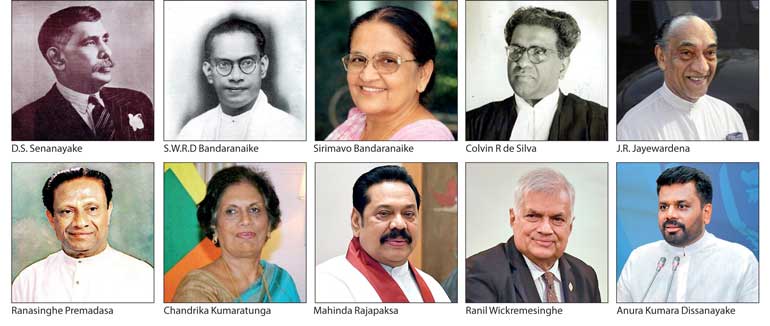
The architects of the republic – Colvin R. De Silva, Sirimavo Bandaranaike, and the Constituent Assembly, et al. – engaged not merely in legal draughtsmanship, but in an act of constitutional self-creation.
A legal luminary of our times famously described it as “an act of autochthony”: a constitution deriving its authority from the people of Sri Lanka rather than an inherited colonial legality.
And yet, more than half a century later, the republic such as it is now remains curiously incomplete; lacking – as Sirimavo’s daughter may have said, “a certain je ne sais quoi”.
Certainly, Sri Lanka achieved juridical sovereignty. However, the question could well be asked whether it has ever achieved even a modicum of republican maturity.
For a republic must be much more than a state without a monarch. It is, ideally and even maybe romantically, a state in which institutions are stronger than personalities, citizenship transcends tribalism, and public office is understood as public trust.
To this prescription add the caveat that sovereignty must genuinely belong to the common or garden people – rather than to dynasties, oligarchies, manipulative populists or political messiahs and their transient disciples.
Irony in a native land
Measured against that standard, Sri Lanka’s republican journey has been troubled. Indeed, there is more than one irony embedded in our troubled history.
The very constitution that embodied Ceylon’s formal emancipation from colonial constitutionalism also accelerated its new internal contradictions and divisions.
The 1972 Constitution strengthened parliamentary supremacy, but weakened institutional restraints.
And by affording a native philosophy ‘the foremost place’, it entrenched majoritarian impulses, and also served to further centralise the state.
What emerged over subsequent decades was not the serene republic envisaged by the postcolonial idealists, but a republic increasingly vulnerable to executive concentration, ethnic vulnerabilities, patronage politics, constitutional adventurism, and chronic authoritarian excursions and encroachment into the democratic space.
The Democratic Socialist Republic of Sri Lanka may have abolished the crown, but it did not quite succeed in dampening the darker appetite for local panjandrum or native king.
Waiting for Godot
That hunger and thirst has shaped much of Sri Lanka’s post-independence political psychology. Again and again, the electorate has gravitated towards larger-than-life redeemers.
These leaders have presented themselves not merely as capable administrators but charismatic saviours. SWRD and Sirima. JR. Premadasa. CBK. Mahinda. Gota. And even Ranil.
Even now, johnny-come-lately political movements are invested with quasi-messianic expectations and constructed around latter-day deliverers of the republic from the depredations of capitalism, cronyism, and corruption. 
All of the above have regrettably collided with institutional reality and other inconvenient truths.
And perhaps, that is the paradox of postcolonial republics.
Having expelled colonial intrusion and imperial authority, the newly-freed often recreate it and replicate foreign oppression with a native strain of domesticated authoritarianism.
In the end, the republic becomes emotionally monarchical; and the royals themselves transmute from the promised golden rulers into base autocrats and petty dictators – or if we’re ever so fortunate, benevolent tyrants.
Rise and fall of conquering sons
Meanwhile, institutions remain fragile.
Political parties become vehicles for parasitic personalities. Public service becomes politicised to ridiculous extremes, a descent from the sublime civil service that set Ceylon apart as a model crown colony in the 1950s and ’60s. Constitutional reforms oscillate between concentration and fragmentation of power.
And every national crisis – from a civil war through the tsunami and other natural disasters to COVID-19 – produces renewed calls. Not for institutional resilience and the patient endurance of the people. But for another ‘strongman’ capable of transcending the system.
Often, these strongmen prove to have feet of clay... and the people are condemned once again to suffer durance vile...
Where sovereignty has gone
And so the republic circles itself. This year’s Republic Day arrives at a particularly revealing moment. Sri Lanka, I suspect you would agree, stands between exhaustion with the way things were and always seemed to be, a world without end, and a transition into the best version of ourselves.
We are, or so some would say, ‘somewhat economically stabilised’, but politically unsettled – governed by the stalwarts of a movement born in rebellion and protest, yet already confronting the sedimented realities of the state they once strove to overthrow.
The deeper question facing the country is no longer whether Sri Lanka is formally sovereign. That question was asked and answered in 1972. The question today is whether sovereignty resides in our island nation’s citizens at all?
Can the republic as it is today protect public wealth from predatory networks? Can institutions function independently of political patronage? Can governments reform the machinery of state without being consumed by it or its deeper, darker avatars? Can citizens imagine the normal functioning of the state without deeply desiring paternalistic deliverers?
These are republican questions. And they remained unresolved to date...
Flicker on the blip screen
Maybe that is why Republic Day sits uneasily in the national imagination today, if indeed it does show up as more than a blip on the radar of the annual calendar.
Twenty second May forces a more uncomfortable reflection: what did we do with our liberty, independence, freedom, emancipation, once it became entirely our own?
Any serious answer to that cannot be a simple one.
Sri Lanka as a republic has survived rebellions, revolutions, insurgencies, insurrections, the Aragalaya and countless other riots. It has lived through deadly civil wars, debilitating terrorism, total economic collapse, and recurrent democratic crises.
Those events and the endurance it engendered in an enervated people is not a trivial matter at all. Mere survival alone is not fulfilment of our deepest desires as a people, a polity, and a still incipient republic.
So you would agree that a republic worthy of a day of celebration requires more than constitutional symbolism and attendant acts of state... if any, that is.
It requires civic trust, institutional integrity, and a political culture mature enough to resist both nostalgia for authoritarian governors to rid us of all our ills – pigs might fly – and revolutionary romanticism.
QED.
Come let us build
I put it to you, gentle republican reader, that building up such a republic remains an unfinished task. And that is why I would argue that 22 May deserves – no, demands – not less attention than 4 February, but more.
Independence Day commemorates the end of colonial rule. Republic Day celebrates and cherishes the beginning of citizen and state responsibility.
Together, state and citizenry must build a republic we call all be proud of.
In a country where public institutions have become subordinate to individual personalities, the cure is not yet another charismatic leader but the deliberate depersonalisation of governance.
Then we could all create a civic republican culture through education and local participation. Since Sri Lanka suffers not merely from constitutional weaknesses but from a political psychology trained over the years to seek national saviours, this mentality cannot be legislated away... it must be culturally retrained – by citizens being helped to internalise republican virtues, the people (you and I, my dear) will over time be less emotionally monarchical.
Thirdly we can or must establish a national ethic of public accountability and shared sacrifice. Sovereignty has too often been captured by predatory networks while the public oscillates between indignant resignation and messianic expectation. The state must act honestly and the public will hopefully respond civically.
Taken together, these three reformist movements tantamount to a single overarching shift: from personality to institution, from subjection to citizenship, and from emotional politics to civic responsibility.
That, arguably, is the republican regime we could begin to yearn for today; and through our concerted actions over the years ahead, truly call into being.
(The author is the Editor-at-large of LMD and is a senior journalist with a Post-graduate Diploma in Politics and Governance)




